Courtney Watts
I find the things a company assumes are already defined, only to discover they never were. Then I build the systems that articulate them to the right people, at the right time, in the right ways.
The weekly managers meeting nobody had asked the purpose of in years. The updated annual goals that, come December, still had not been written down or articulated. The company's most prestigious award, ten thousand dollars attached, that the executive team could not define while they sat in a room choosing who deserved it.
Each time I named it, and then I built the thing that fixed it. I did that at Imperative Chemical Partners, a 1,000-employee, $500M enterprise, where the internal communications function exists because I built it. No predecessor, no playbook, no team.
Before that: 17 years inside Plano ISD as a teacher, gifted specialist, and campus leader. M.Ed. in Educational Leadership. Texas principal certification. Trained in Prosci and ADKAR change management. Member of IABC and the Professional Speechwriters Association, two of the communications field's most established professional bodies.
Selected Work
The PCC Acquisition
One deal, several audiences
Imperative acquired Performance Chemical Company, a midstream provider in Midland founded fifteen years earlier by two brothers who were now retiring. Two workforces had to read the same email and each come away with something different. Imperative employees needed to know why the company had spent the money. PCC employees needed to know whether their company still existed, whether they still had a boss, and whether the thing their founders built was about to be erased. Most acquisition announcements pick a side. Usually the acquirer's.
The same deal, several messages, several audiences. The internal email spoke to two workforces at once. This press release spoke to the market. An in-person kickoff welcomed the new teammates. A planned sequence carried the story from the announcement through integration.
Team,
Imperative continues to grow and seize new opportunities in our dynamic industry. I'm thrilled to announce that we have acquired PCC (Performance Chemical Company), a leading chemical services provider. This strategic acquisition enhances our position in the Permian Basin, specifically in the midstream sector, which aligns with our growth strategy.
Performance Chemical Company, founded 15 years ago by [the founders], brings a wealth of experience and a strong reputation in the midstream market. Based in Midland, Texas, PCC's loyal customer base, growth track record, and team of skilled professionals complement our existing capabilities and team. As we welcome this strong organization to our family, I want to thank [them] for their vision and leadership as they retire from the business. We look forward to the exciting opportunities this combination creates for our customers and employees.
[PCC's Director of Operations] will continue leading the organization as we determine the best path forward for integration. [His] industry knowledge and leadership skills, along with those of many other team members, will be invaluable as we integrate our operations and pursue new growth opportunities together.
In the coming days and weeks, we will begin the process of bringing our two companies together, with the goal of operating as one unified organization by early 2025. We're committed to a smooth transition that minimizes disruptions for both PCC and Imperative customers and employees. As we progress, we'll keep you informed of important developments and any changes that may affect the broader organization.
I want to thank each of you for your continued dedication and hard work. Your efforts have made Imperative the innovative, first-class company we are today. Please join me in welcoming the Performance Chemical team to the Imperative family!
Signed: Chief Executive Officer
The public press release · also written by me
MIDLAND, Texas, Oct. 7, 2024 — Imperative Chemical Partners today announced the acquisition of Performance Chemical Company (PCC), a leading provider of specialty chemical solutions primarily serving midstream and production operators. This marks Imperative's second acquisition of the year, following the successful integration of Western Chemical, and represents a key step in expanding its depth and breadth of services.
"As I step into retirement, I want to express my deepest gratitude to the entire Performance Chemical team," said [PCC's founder]. "Your dedication, hard work, and passion have been the driving force behind our success over the past 15 years."
"This acquisition is a strategic milestone... enabling us to continue delivering the highest level of customer service by further scaling our operations," said Ryan Havens, CEO of Imperative.
Published on PR Newswire and the company newsroom. Public and verifiable.
The same deal, written for a second audience. The internal email above spoke to two workforces at once. This spoke to the market: analysts, customers, competitors, and future acquisition targets. One event, two entirely different documents, both mine.
The decisions behind it
- Business rationale before sentimentThe first substantive line is the strategy, not the celebration. An announcement that opens with "I'm thrilled" and never says why the company did this is a press release wearing a friendly hat. Give people the reason first; they can decide how to feel about it once they understand it.
- Honor what was built, by nameFifteen years. The founders. Their reputation. Their retirement. This is not politeness, it is the most important paragraph for the acquired workforce. People who spent fifteen years building something are watching to see whether the buyer will pretend it never mattered. It costs one paragraph and buys six months of benefit of the doubt.
- Answer the real question third, not lastEvery PCC employee had exactly one question, and it was not about the Permian Basin. It was do I still have a boss, and is it still him. That answer sits above the timeline and above the thank-you, because it is the only sentence some readers will absorb. Put the answer where the anxiety is.
- Name a date. Concede the disruptionA date converts open-ended dread into a bounded process. And "minimizes disruptions" does honest work: it admits there will be some. "There will be no disruption" is a promise that breaks within a month, and when it breaks, every future message from leadership is discounted.
- Set the cadence in the first message, then keep itThe announcement promised to keep people informed, so the schedule was set from day one: a substantive integration update on November 15, then a video from leadership on November 21, because at some point people need to see a face, not just read a paragraph. A planned rhythm is what keeps the weeks after a deal from filling with rumor. The interval was deliberate, not a gap.
Two multimillion-dollar acquisitions led end to end. Pre-close planning, leader preparation, announcement sequencing, press release coordination, and post-close integration messaging.
The sequence was the strategy. Anyone can write one announcement. Uncertainty in the weeks after a deal is the window where a workforce loses confidence, and once it goes it does not come back on a schedule. That window is a communications problem, and most companies never plan for it.
The Texas Hill Country Floods
Crisis communications, seventy-two hours in
The July 4th floods killed and displaced people across the Hill Country. Employees of ours were directly affected, and search and rescue was still underway when this went out. A message like this has three ways to fail. It can be too corporate, a statement of thoughts and prayers that produces nothing. It can be too vague, so a thousand people are moved and none of them act. Or it can exclude everyone who is not local, leaving the other ten states standing outside a door they wanted to walk through.
Not everyone has cash, proximity, or a free Thursday. Three audiences inside a single email, each told plainly which one they are. Please help produces nothing. Bring bleach to East Campus by Thursday produces a truckload.
Team,
The devastating floods in the Texas Hill Country have brought profound tragedy and unimaginable loss to our friends and neighbors, and some of our own have been directly affected. We're checking in with those we know about, but if you or someone on your team has been impacted and we haven't heard, please let us know. While Texas is home to many of our teammates, Imperative stretches across 11 states, and no matter where you are, you can still be part of this effort.
Imperative has already secured supplies for the West Texas Food Bank, which is providing critical relief on the ground. You can help in three immediate ways:
Donate Supplies
The Food Bank has provided an updated list of urgent needs:
- Bleach
- Brooms
- Shovels
- Cleaning supplies
- Trash bags
- Bug spray
- Socks
- Baby wipes
- Diapers
- Non-perishable food
Drop off items at either the East or West Campus, or take them directly to the West Texas Food Bank. They'll transport items to the Hill Country at the end of the week, or sooner if a trailer fills up.
Volunteer Your Time (Permian)
The Food Bank needs help on Thursday afternoon/evening, July 10th, to sort donations and load trucks for about 2-3 hours. If you'd like to volunteer, fill out this form and we'll communicate more details about the times as soon as possible.
Donate Financially
Search efforts are still ongoing, and these organizations are meeting critical, in-the-moment needs:
- Community Foundation of the Texas Hill Country
- Texas Search and Rescue
We’ll continue to share updates and opportunities to help in the days and weeks ahead. Thank you for being the kind of teammates who show up when it matters most. Our support doesn’t start and end today. Not for the Hill Country, and not for you.
The public post · also written by me
"Some moments from 2025 left a mark on all of us, none more deeply than the devastating flooding that hit the Texas Hill Country this summer. Lives were lost, homes were swept away, and families faced unimaginable devastation. The heartbreak reached right into our own Imperative family.
When the floods hit, our teams did not stand on the sidelines. We stepped in. Employees rallied together by donating supplies, giving financially, checking on teammates, and volunteering where help was needed most. In partnership with the West Texas Food Bank, #TeamImperative volunteered to pack more than 19,000 pounds of food for Texas families, over 100 hours committed to supporting relief efforts.
At our core we are:
A team that shows up.
A team that serves.
A team that takes care of people."
Published on the company's LinkedIn page. Public and verifiable: linkedin.com/posts/teamimperative-teamimperative-hillcountrystrong-ugcPost-7401984041727528960-j7Lt

The internal email made the ask. The public post reported what came back. Same writer, opposite jobs: one had to move a thousand people to act inside a week, the other had to tell the outside world who the company turned out to be. And the post ends on a team that shows up, not on a number, because the number is only worth what it says about the people.
The decisions behind it
- Name it honestly, in the first lineNot "the recent weather events." Profound tragedy and unimaginable loss. And immediately: some of our own. Employees can tell within one sentence whether a company means it, and most fail that test by reaching for the safest available language.
- Admit the company does not know everythingThe sentence most companies never write. It concedes the picture is incomplete, opens a channel back, and quietly instructs managers to look at their own teams. Across eleven states, leadership genuinely does not know who is in trouble. Pretending otherwise is how someone falls through. Humility here is not softness. It is operational.
- Solve the exclusion problem out loudSomeone reading this in North Dakota wants to help and assumes they cannot. That is a real feeling and it produces real disengagement. One sentence lets a thousand people in.
- The company gives before it asksNever ask employees to donate before the company has. A request from a company that has done nothing reads as outsourcing its conscience. One line establishes standing to ask, with no self-congratulation.
- Three doors, sorted by what people can actually giveSupplies for anyone. Time for the Permian only, explicitly labeled. Money for those who cannot show up. Audience segmentation inside a single email. Not everyone has cash, proximity, or a free Thursday. Give people more than one door and most will walk through one.
- Specificity is the empathyBleach. Brooms. Diapers. East or West Campus. Thursday the 10th, two to three hours, here is the form. Two relief organizations, already vetted, so nobody has to wonder whether their money lands somewhere real. Please help produces nothing. Bring bleach to East Campus by Thursday produces a truckload.
- Get the one word rightNot recovery. Not rebuilding. Search. People were still missing. A reader in that region would have felt the difference instantly, and getting it wrong would have been unforgivable.
19,000 pounds of food packed. More than 100 volunteer hours. Reported publicly by the company, in partnership with the West Texas Food Bank. And an affected employee's family received direct support.
Thank you for what you do... [his] wife is extremely distraught, as she should be. [He] is overwhelmed with thankfulness for what our team has provided for them.— a colleague, by reply
That is what an internal communication is for. Not just open rates. The teams showed up, packed the trucks, and helped a colleague's family through the worst week of their life. My job was to make showing up the easy thing to do.
From Broadcast to Cascade
Taking the life of the forum I was keeping alive
A note on why this one is here. The artifact below is not my strongest piece of writing, and I would not normally include it in a portfolio. I am including it here because it is the clearest example I have of how I think about internal communications: as architecture, not output. The story could also be read as criticism of the company, but I am including it anyway.
The weekly all-manager call was a longstanding institution nobody had audited in years. Fifteen minutes, every manager in the company, and a different presenter every week: a manager one week, a director or VP the next, an executive after that, each with an unrelated update. It had drifted into a rotating cast broadcasting four unrelated topics a month at 300 people. It was diluting the leadership message it existed to carry, and nobody wanted to present. What I was good at was producing it. Each week I found the right person to speak, listened across the business for the updates the organization actually needed to hear, built and tailored each presenter's deck, and coached them on delivery. I even built in engagement: trivia pulled from past sessions, with swag for whoever got the most right. It was a show, and it was produced well. It just was not working.
The recap below is one artifact from that old format, which I wrote monthly to keep the content alive between sessions. It is here as evidence of what the format was, not as the thing I am proud of.
One message to 300 people is generic by construction. The same message carried by fifty leaders who each know their own people arrives fifty different ways and lands every time.
Team,
15 minutes each Friday morning can fly by quickly. I want to bring back the relevance of the October topics because each one is pivotal to the growth of our organization.
Take a moment to look over the recap below:
Week 1: Performance Acquisition Announcement
Led by: [Chief Executive Officer]
- Acquisition of Performance Chemical Company
- Result of 6+ months of careful evaluation and due diligence
- Positions the company for significant growth in 2025
Week 2: Q3 Business Development Update
Led by: [VP, Business Development]
- New strategic accounts added; expansion within existing accounts
- Notable growth across multiple service lines
Week 3: mPP Ambassador & Steering Committee
Led by: [two functional leaders]
- Ambassador role now links field users to the steering committee
- Call to action for managers: encourage your team to actively engage with their ambassadors.
Week 4: Order to Cash
Led by: [Director of eBusiness]
- DSO improved from 77 to 67 days quarter over quarter
- New KPI targets established across invoicing, validation, and exception handling
Core Value Moments
- A service technician recognized for initiating field training for his team
- The exception handling team commended for a significant transaction volume
See everyone tomorrow morning at 7:30 AM Central Time!
Courtney
The decisions behind it
- Read the first line as a confessionFifteen minutes can fly by quickly. I want to bring back the relevance of the October topics. That is me admitting, in writing, every month, that the forum was not landing. I was good at the rescue. Being good at a rescue is not the same as not needing one.
- Four unrelated topics is not a messageAn acquisition, a BD update, a platform ambassador program, and accounts receivable. Each one mattered to someone. None of them mattered to everyone. A broadcast that tries to serve every audience serves none of them, and a manager sitting through three segments irrelevant to her team learns to stop listening.
- The diagnosis was the audience, not the contentThe forum was not failing because the content was weak. It was failing because it was aimed at every manager in the company at once, which meant it could only ever be generic. The fix was not a better broadcast. The fix was to stop broadcasting.
- The redesign concentrated the message, then cascaded itI advised the CEO to reset the forum and rebuild it around a smaller room. The new model was a live call for Directors, VPs, and above only, carrying a concentrated message. Those leaders then received materials and talking points, and led their own calls with their own teams, tailored to their function.
- Why this is better, and it is not subtleOne message to 300 people is generic by construction. The same message, carried by fifty leaders who each know their own people, arrives fifty different ways and lands every time. I stopped trying to speak to the whole company and instead armed the people who already had the relationships. That is the difference between informing an organization and enabling one.
- I took the life of the thing I was good atThe thing I was good at was not the recap. It was producing the whole weekly show: sourcing the speakers, shaping their message, coaching their delivery, even running the trivia and the swag. I was good at it, and I advised the CEO to end it anyway, because being good at running a format is not the same as the format working. The work is not to be indispensable to a broken system. The work is to fix it.
The redesigned model launched and ran: a concentrated leaders-only call for Directors and VPs, followed by materials and talking points, cascaded by each leader into function-specific conversations with their own teams.
An honest note about this sample. The materials from the redesigned model are not in my possession. What I can show is the artifact from the format I replaced, and my reasoning for replacing it. I would rather show you the real evidence of a problem I solved than a reconstruction of the solution.
The Lion Award
Making an executive team define the thing before they voted on it
The Lion Award is the company's highest honor: $5,000 to the employee, $5,000 to a charity they choose. I was facilitating the executive team's selection. Partway through the discussion I realized they were arguing past each other, and I understood why. Nobody in the room could say what the award was actually for. Absent a definition, they were reaching for the four corporate core values, which already had their own separate recognition program running alongside this one. Two systems, one set of criteria, and the most prestigious thing the company gave away had quietly become a duplicate of something else.
So I stopped the selection and asked them to define the standard before they chose against it.
There was already evidence of what the vacuum cost. In 2023 the company gave the Lion Award to two people. Both were deserving. But with no shared standard to choose against, the room could not land on a single name, so it split the award rather than make a call it could defend. That is what an undefined award does: it stops being an honor and becomes a negotiation.
2024 was the first cycle run on the new standard. By 2025 it had fully taken hold. Nominations went from 56 to 143. The number of employees nominated by their peers went from 36 to 90. Same company, same headcount, same $10,000.
The question the old form asked
"What core values does the nominee demonstrate?"
This is the whole problem, printed on the form. The instrument was not neutral. It reached into the nominator's hand and pointed it at the wrong program. Every nomination that came back was evidence for an award that already existed, which meant the executives were reading the wrong case and then wondering why the decision felt arbitrary.
The question the new form asks
"How has the nominee demonstrated characteristics of Lion Mentality? Please provide examples of their Attitude, Effort, and Discipline in their role at Imperative Chemical Partners."
Three words. Not four values, not a mood. A standard a shift supervisor in Roosevelt, Utah can apply to the person working next to him.
And the packet I built them to decide with
- A four-year trend dashboard on page one. Nominations and nominees, 2022 through 2025, before a single name appears.
- Repeat-nominee tags. Every name in the index is marked if the person was also nominated in 2022, 2023, or 2024. Sustained regard is different from a good quarter.
- A frequency ranking. One employee drew ten separate nominations. Another drew eight. That is a signal, and it was invisible in a stack of paper.
- Structured, comparable profiles. Title, department, employed since, total nominations, nominated by. The same fields in the same order for all ninety people.
177 pages. Ninety nominees. One decision.

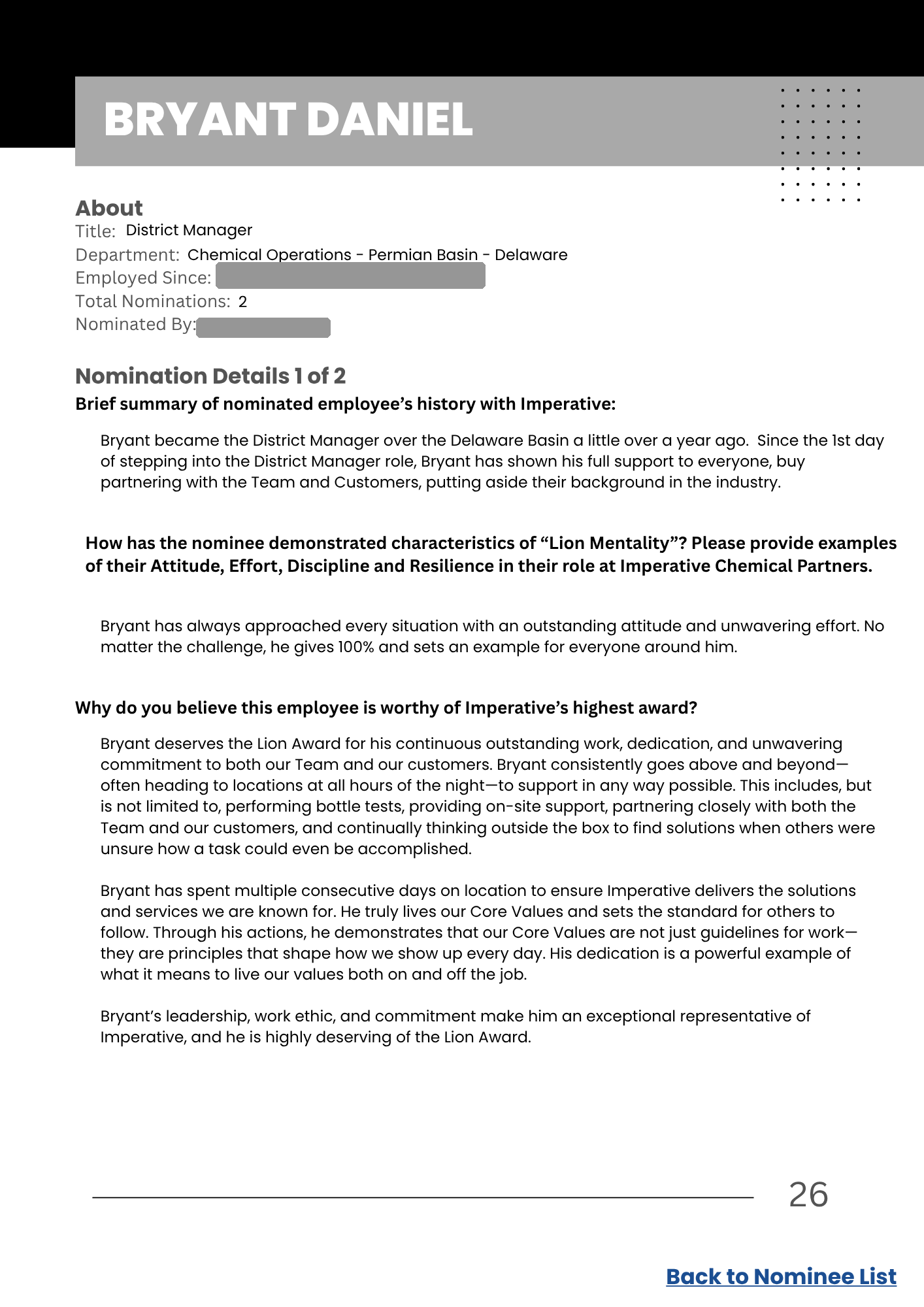
The internal announcement, 2024 · the first winner chosen under the new standard · written by me

We are proud to announce that Imperative’s 2024 Lion Award winner is Shane Burt, Director of Fleet & Facilities.
Shane’s journey from treater truck driver to director exemplifies what the Lion Award represents. This prestigious honor, our highest recognition, celebrates those who embody our Lion Mentality through attitude, effort, and discipline. Shane demonstrates these qualities daily, whether he’s resolving fleet challenges, ensuring proactive facility management, or stepping in alongside his team during demanding situations.
His leadership style combines unwavering determination with genuine compassion for his team. He’s known throughout Imperative for his hands-on approach, positive attitude, and ability to turn obstacles into opportunities for growth.
Shane doesn’t just manage a critical support function. He elevates it, inspiring everyone around him to be better. His impact extends far beyond his role, making him truly indispensable to our Imperative team.
Please join us in celebrating Shane for this well-deserved recognition!
Sent company-wide, signed by me as Manager, Internal Communications.
Even the first announcement carried the new language. Attitude, effort, and discipline appear here, in the very first cycle run on the rewritten standard. A year later they surface again in the public announcement below, and in the company’s own hashtags.
The public announcement, one year later · written by me
"We are proud to announce that Imperative's 2025 Lion Award winner is Bryant Daniel, District Manager for the Permian Basin.
His leadership is defined by consistency, accountability, and doing the right thing, especially when it's hard. Known for being demanding but fair, he sets clear expectations and coaches his team toward growth and success.
People naturally follow him because of the trust he builds with both his teams and his customers. He brings clarity and stability to fast moving environments and supports his people through challenges with steadiness and intention.
Through a balance of high standards and genuine support, he has become a benchmark for leadership at Imperative Chemical Partners."
Company LinkedIn page. Public. 155 reactions, the page's most engaged post.
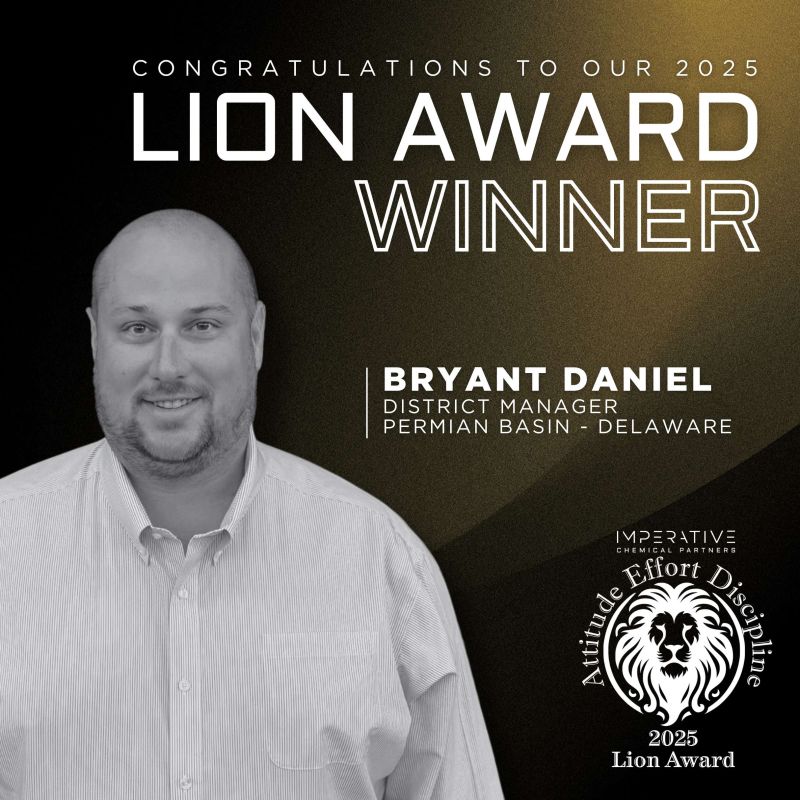
Read the hashtags. Attitude. Effort. Discipline. Those are the three words an executive team could not produce a year earlier, when they were sitting in a room trying to give away ten thousand dollars. Nowhere in this announcement do the corporate core values appear. The standard did not just get written down. It became the language the company reaches for, in public, without being asked to.
The decisions behind it
- Challenge the room live, not in a memo afterwardI was there to facilitate, which meant the safe move was to run the meeting I was asked to run and raise the problem later, in writing, where nobody has to look at anybody. Later is where good observations go to die. The decision was being made in that room, that hour, and once it was made it would have been defended for a year.
- A lack of definition stalls the decisionIn 2023 they gave the award to two people. Both were deserving. But with no shared standard to choose against, the room could not land on one, so it split the award rather than make a call it could defend. A split looks generous. It is actually a leadership team unable to decide, and everybody downstream can feel it. The award had been quietly degrading for years and the two-winner year was the symptom nobody read.
- You cannot select against a standard that does not existThey were not being careless. They were being asked to choose the most deserving person without anyone having said what deserving meant. In that vacuum a group reaches for the nearest available language, and the nearest available language was the core values. The failure was structural, not personal, and that is exactly why naming it was not an accusation.
- Find the culprit in the instrument, not in the peopleThe form asked what core values does the nominee demonstrate. Of course the nominations came back about core values. A leading question produces a leading answer, and then everybody blames the answer. Most people would have retrained the nominators. I changed the question.
- Two recognition systems need two sets of criteria, or you have oneThe core values already had their own program. If the company's highest honor uses the same criteria as its everyday recognition, the highest honor is just a bigger version of the everyday one, and it stops meaning anything separate. I also overruled brand materials that were conflating the two, because the visual system was teaching the same confusion the form was.
- Three words, not a paragraphAttitude. Effort. Discipline. A standard that a field supervisor can hold in his head while he thinks about the person on the other end of the truck. If your criteria need a slide to explain, nobody will use them, and you will be back to arguing in a room next January.
- Give executives a decision instrument, not a stack of paperNinety nominees is not a reading assignment, it is a data problem. So the packet leads with four years of trend, tags who has been nominated before, ranks who was nominated most, and renders all ninety people in identical comparable fields. The work was not assembling the nominations. It was making ninety subjective testimonials into something a leadership team could actually reason over.
Nominations grew from 56 to 143. Employees nominated grew from 36 to 90. 2024 was technically the first cycle under the new standard, but rewriting a narrative everyone already understands takes time. By 2025 it had taken hold.
But the number is not the result. This is: the company's public announcement of its 2025 winner, which I wrote, describes him entirely in terms of consistency, accountability, and doing the right thing when it is hard. It carries the hashtags #Attitude #Effort #Discipline, and it does not mention the core values once.
A year after a definition did not exist, it had become the language the company used in public to describe its own highest honor. That is what it looks like when a communications decision stops being a communication and becomes how an institution thinks.
Inside Imperative
Making a company visible to itself
A thousand people across 11 states. Labs, yards, rail terminals, field crews. The problem was not that employees lacked information. It was that they had no evidence the rest of the company existed. A service tech in Roosevelt, Utah had no idea there was a lab opening in Williston or a rail facility coming online in Odessa. He could not feel part of a thing he could not see. So I built a newsletter. Not a morale piece. An instrument for making the company legible to the people inside it.
The artifact below is not the newsletter. It is the editorial calendar that produced it, and it is the more honest exhibit of the two. Anyone can lay out a nice PDF. The hard part is getting nine functions to feed one publication on a deadline, which is where most internal newsletters quietly die.
Every line names a specific owner, not just a function. Pairing each item with an accountable person is what turns an editorial plan into content that ships on deadline.
MONTH 1 · Theme: Introducing Inside Imperative
- Leadership Corner — Welcome message explaining the newsletter's purpose · Source: CEO · Due 5/20
- People & Culture — Employee spotlight, a different region each issue · Source: District Managers / Account Managers · Due 5/15
- Business & Operations — Customer journey map, visual of the service process · Source: Operations · Due 6/18
- Safety & Development — Safety success story, a recent "Good Catch" · Source: [named individual] · Due 5/15
- Innovation — Problem solver: a creative fix to a recent challenge · Source: [named individual] · Due 5/15
- Education — "Did You Know?" on a core product. Keep it simple. · Source: Product Technology · Due 5/18
- Milestones — Anniversaries, certifications, promotions · Source: Regional Managers / HR · Due 5/15
MONTH 2 · Theme: Objective Measurement & Customer Success
MONTH 3 · Theme: Employee Connectivity & Team Excellence
Same seven categories. New owners, new deadlines, a theme that carries the issue.
Ongoing every month
- FAQ, community involvement, and upcoming industry events, plus lighter touches: company trivia and a wellness tip
Note to self, in the plan: "Test with groups to see what their commitment would be. Start small, grow big."
The published artifact · Issue 1, January 2026
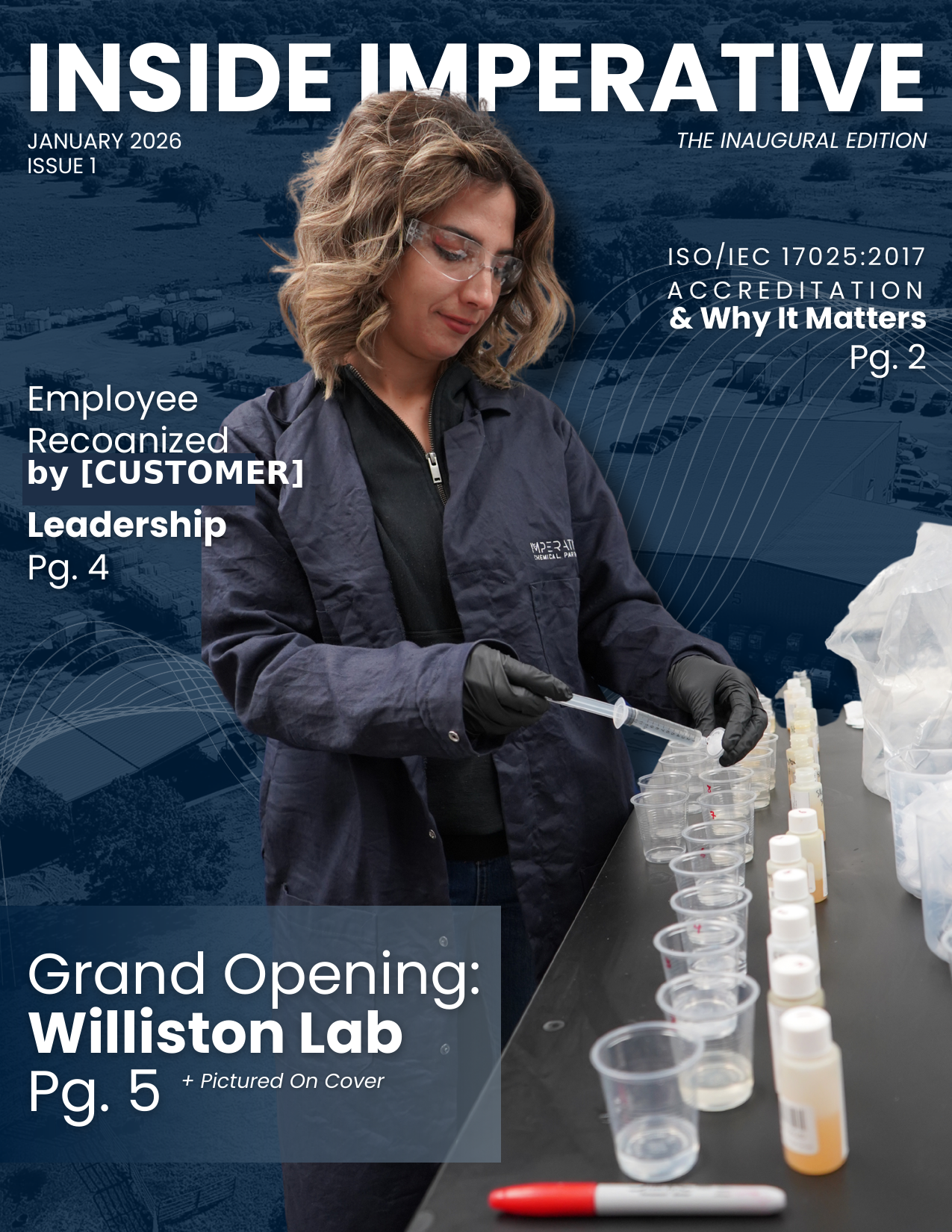
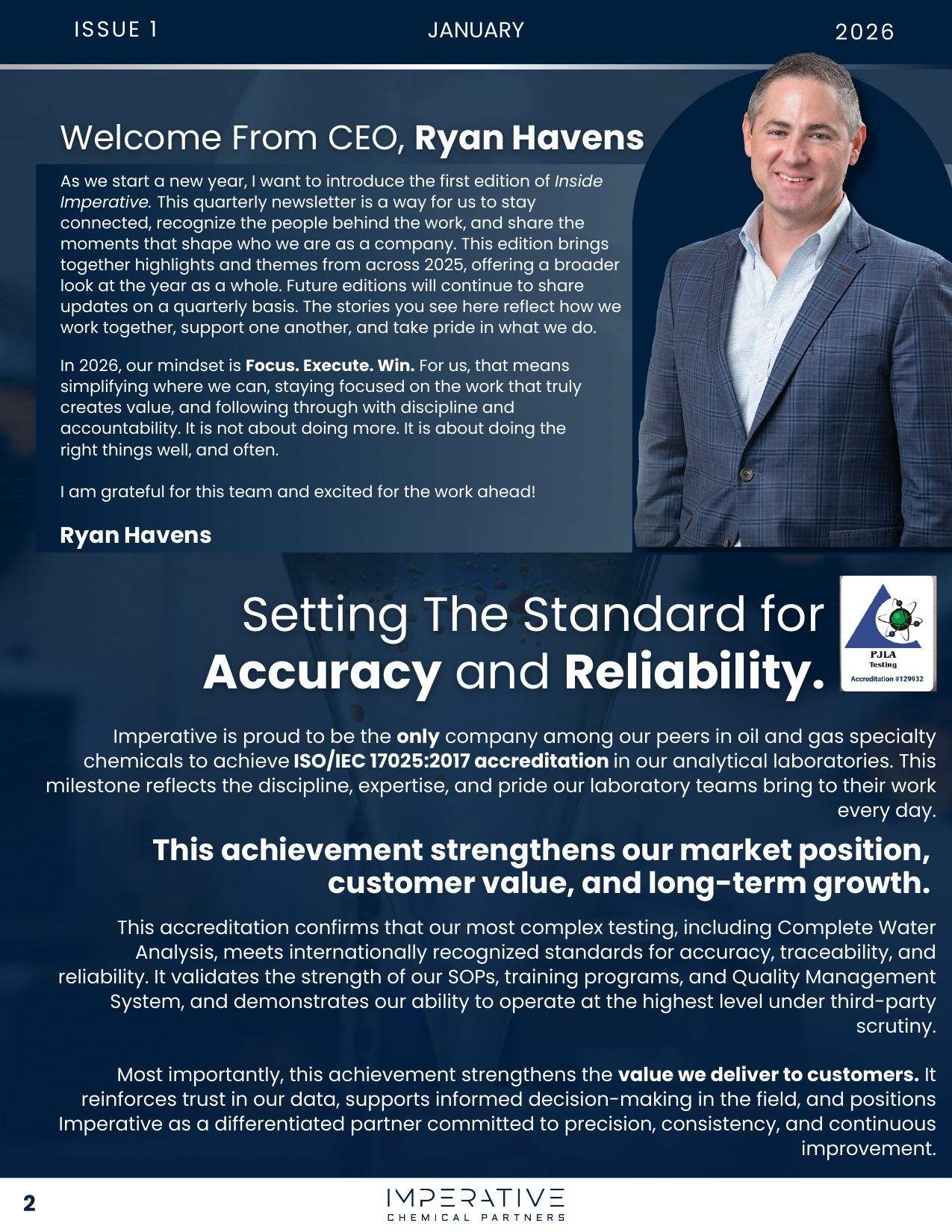
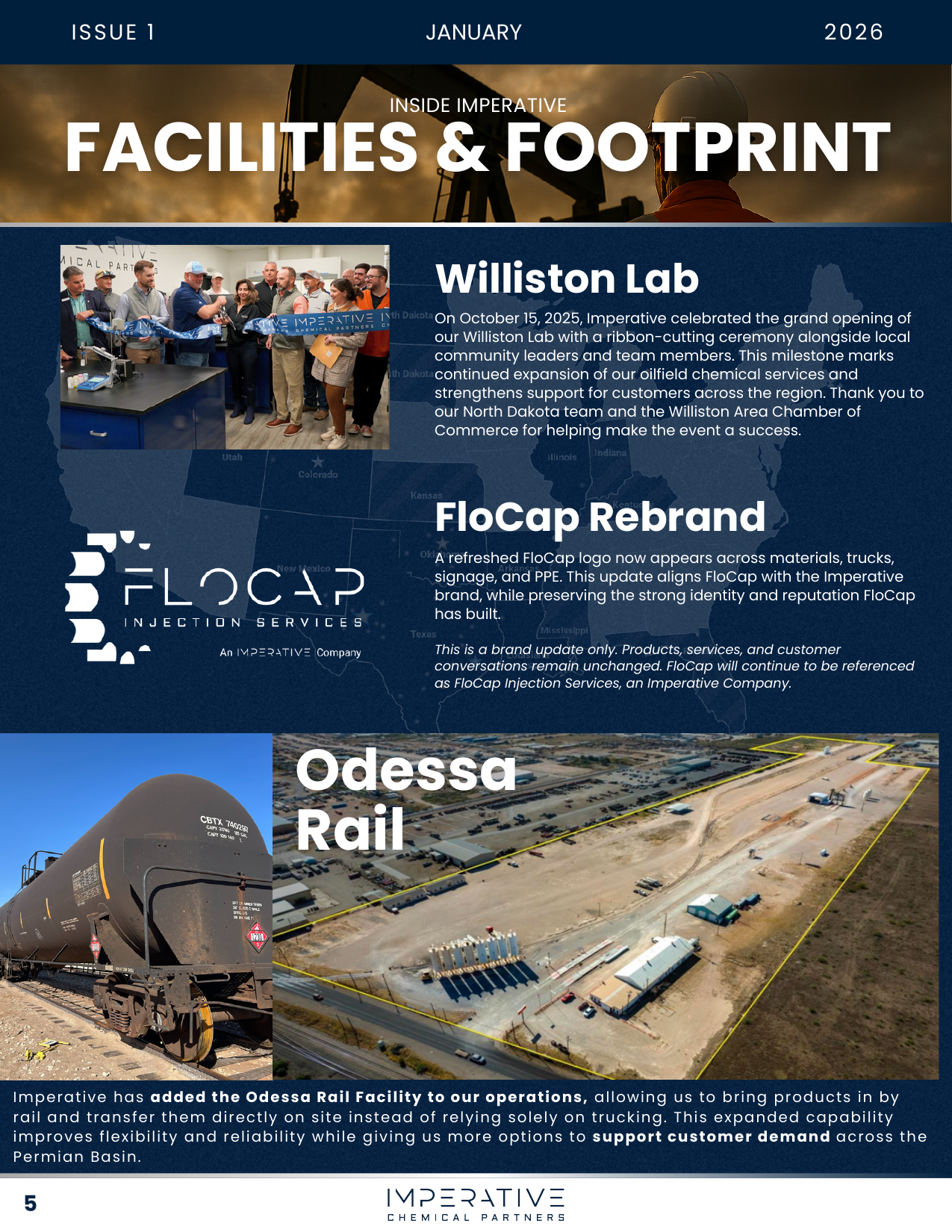
The CEO’s welcome, in full · written by me, in his voice
Welcome From CEO, Ryan Havens
As we start a new year, I want to introduce the first edition of Inside Imperative. This quarterly newsletter is a way for us to stay connected, recognize the people behind the work, and share the moments that shape who we are as a company. This edition brings together highlights and themes from across 2025, offering a broader look at the year as a whole. Future editions will continue to share updates on a quarterly basis. The stories you see here reflect how we work together, support one another, and take pride in what we do.
In 2026, our mindset is Focus. Execute. Win. For us, that means simplifying where we can, staying focused on the work that truly creates value, and following through with discipline and accountability. It is not about doing more. It is about doing the right things well, and often.
I am grateful for this team and excited for the work ahead!
Ryan Havens
The decisions behind it
- Assign content to people, not to departmentsEvery line names a human being. Not "Operations." A person in Operations. Departments do not send you anything. People do. That single choice is the difference between an editorial calendar and a wish list, and it is the thing most internal communicators get wrong on their first try.
- Backward-plan from the ship dateContent due two to four weeks ahead, staggered by how long each source realistically takes. The CEO gets the longest runway because executives always do. This is production planning, and it is the reason the thing shipped at all.
- Then the organization did not feed itIt was designed as a monthly, launching in June. It shipped as a quarterly, in January. I built the supply chain correctly and the functions did not deliver into it. That is the most common way an internal newsletter dies, and I had anticipated it, which is why I named individuals instead of teams. It still was not enough.
- So I cut the cadence rather than ship a starved productMonthly became quarterly. This is the decision I would most want a hiring manager to ask me about. The alternative was four thin issues that would have killed the franchise by embarrassment. A newsletter that visibly struggles to fill itself teaches employees that nothing is happening. One substantial issue teaches them the opposite. Right-size the plan to the actual supply.
- Cut the filler, raise the seriousnessTrivia, wellness tips, birthdays, FAQ: all planned, none survived. What shipped was an ISO 17025 accreditation, a safety commendation from a customer's leadership, four asset wins, a lab opening, a rail terminal, and company meetings across 11 states. A field workforce can smell a morale newsletter in about four seconds. Give them the business, and the recognition lands because it sits next to something real.
- Turn the delay into the premiseSeven months late meant twelve months of banked material. So Issue 1 became a year in review, and the first edition of a quarterly opened by accounting for the entire prior year. The constraint became the editorial concept.
- Write the CEO's welcome in his voice, and hand it to him"It is not about doing more. It is about doing the right things well, and often." That is the company's 2026 operating mindset, articulated in the CEO's letter, written by me. Holding an executive's voice is not ghostwriting his sentences. It is being trusted to decide what he thinks in print.
- Print it, because email does not reach a truckHard copies were printed and shipped to the individual yards, and left in the workrooms and lunch areas. More than half this workforce does not sit at a desk. An internal communication that only exists in an inbox is an internal communication that excludes the people doing the work. The channel decision is the audience decision.
One issue shipped. Thirteen pages, ten recurring departments, nine functions feeding it, and a paper copy in every lunchroom across 11 states. It carried the ISO accreditation, the Chevron safety commendation, the Core Value Coins, and the Imperative University numbers, which meant the recognition architecture finally had somewhere to be published.
Why the exhibit is the calendar, not the entire issue. Anyone can lay out a nice PDF. The calendar is the proof that this was a system: nine functions, a named owner on every line, and a distribution plan built to reach the people who do not sit at a desk.
The Show Behind the Show
A run-of-show, a comedy script, and an executive speech, in one document
Every company throws an annual awards banquet, and most are a slideshow and a buffet. I produced ours: a special, invite-only night for a room of 200. The problem with corporate recognition is that nobody wants to sit through it, and the moment that matters, the winner, arrives after the room has checked out. So I did more than write remarks, though I wrote plenty, including the CEO's speech and a Lion Award tribute that withheld the winner's name until the final line. Around it I engineered a build: the night opens by introducing every nominee, narrows at the midpoint to the Top 10, and ends on a single name. A thirty-segment run-of-show on the format of a late-night talk show, with the comedy up front so the room is fully present for the one moment the whole evening exists to deliver.
Most people write remarks. This is a produced show. The whole night is a build: it opens by celebrating every nominee, narrows at the midpoint to the Top 10, and ends on a single name. Ninety minutes engineered so the room earns the winner.
The run of show (30 segments)
Opening · Welcome · Mean Tweets · Rejected Mascots · Thank-You Notes · Lion Award intro + promo video · Nominee recognition · Dinner · CEO Confessions · Lip Sync Battle · Top 10 · 10-Year Awards · Finalists · Individual awards · Lion Award finale + winner reveal · Closing · Mixer.
Open the full run-of-show and script (redacted PDF) → Names redacted; the CEO and public winner are named.
Register one: comedy that knows the company
An opening bit, a fake acquisition announcement:
"Ryan will kick us off with the announcement of Imperative’s newest acquisition: Walmart. Thousands of new teammates. Integration will take less than three months."
And the rejected mascot ideas, written to roast the culture:
"Napping Lion: the king of the jungle sleeps 16 to 20 hours a day, just like some of our treaters. Dallas Cowboys: all the best resources, mediocre performance. Bruno from Encanto: we don't talk about spills, no no no. Shrek: we may not be pretty or smell good, but we get things done."
Register two: the CEO, written human
"Tonight combines two things we love: recognizing the exceptional people of Imperative, and staying within budget. I’ve developed a few jokes of my own and was really thinking about doing a joke about chemistry…but I was concerned it wouldn't get a reaction…"
Written for the CEO to deliver. Making the top of the company laugh at itself is how you earn the room before you ask it to feel something.
Register three: the reveal everyone’s been waiting for
"Picture someone who didn't just climb the corporate ladder, but rebuilt it with their own hands. From a treater truck driver to a critical leadership position, their story is a masterclass in determination... Please join me in congratulating our Lion Award winner, Shane Burt."
One writer. One document. Three completely different voices, delivered by a rotating cast to a 200-person room, all engineered to build from 49 nominees to 10 finalists to one winner.
The decisions behind it
- Build it on a format the room already lovesNobody wants to attend a corporate awards ceremony. Everybody wants to watch a late-night show. Borrowing a familiar format turns an obligation into entertainment people actually lean into.
- Write the CEO to laugh at himself firstThe chemistry joke that would not get a reaction, the budget bits, the confessions. Making leadership human at the open is what buys you the silence you need at the close. A room will not feel something for a company it is not enjoying.
- Engineer the energy, minute by minuteThirty segments sequenced so laughs, dinner, and awards never collide. Five video intros, each cued to play two minutes before a transition so the room is never watching a stagehand. Production is a writing job before it is a logistics job.
- Spend the whole night earning one momentThe night narrows deliberately: everyone nominated is celebrated at the open, the field cuts to the Top 10 at the midpoint, and only at the end, after ninety minutes of jokes, comes the one name. The reveal lands precisely because the room was laughing five minutes earlier and has watched the field narrow all night. Range is not showing off. It is the mechanism. You cannot move people you have not first disarmed, and you cannot land a winner the room has not watched you build toward.
A produced, ninety-minute show for a 200-person invite-only room, written and run by one person, and built as a funnel from 49 nominees to 10 finalists to one winner. The Kickoff and its awards banquet are the emotional center of the company's year, and over the same period, nominations for the Lion Award at its center climbed from 56 to 143.
This is the sample that a job description cannot ask for by name. Anyone can claim town halls and all-hands. Handing over the script and the run of show, and proving you can make a room laugh, hold the suspense across ninety minutes, then land a single name in total silence, is a different kind of evidence.
On confidentiality. Every sample here has been sanitized. Individual names, customer references, and non-public figures have been removed or genericized. Photographs are unaltered; the people in them are employees, photographed for internal publication with the company's knowledge. Company names are retained only where the events were publicly announced. The writing, the structure, and the judgment are unchanged. Highlighted passages mark the choices discussed alongside each piece.